In the period 1954 - 1996 M/S Elbjørn was an active part of the Danish icebreaker service. The career as icebreaker ended abruptly on February 12th, 1996, when a DC dynamo exploded. Elbjørn could proceed to port under its own power, but it was clear that its icebreaker days were over. Today, Elbjørn at Aalborg’s waterfront, where the ship operates as a restaurant and museum ship.
Building Instructions are in:
English, German and Danish
Calypso representerer oppfyllelsen av en drøm for sin eier Jacques-Yves Cousteau, en verdenskjent marin forsker hvis dykketeknikk og mange i hovedsak har blitt bidratt til et dekke av sjøhemmelighetene.
I 1950 kjøpte Cousteau en 8 år gammel, amerikansk bygd minerydder, som etter omfattende endringer og modus ble et fullt utstyrt marimt forskningsskip.
Calypso seilte sin jomfrureiser i Rødehavet i 1951, og siden den gang har Cousteau, sønnen Philippe og et team av forskere utført utallige undervannsstudier og vitenskapelige eksperimenter over hele verden.
Cousteau har skrevet flere bøker om sine erfaringer, men Calypso er sannsynligvis mest kjent gjennom de mange spennende TV -programmene som er blitt spilt inn om sine reiser.
Calypso er 42 m lang, veier 360 tonn og har en toppfart på 12 knop. Skipet er utstyrt med mye spesialutstyr som muliggjør mange detaljerte observasjoner, prøvetaking, fotografering og eksperimenter. Utstyret inkluderer et observasjonskammer i baugen, en oval dykkerklokke, et Galaezzi -dykkekammer, en oppblåsbar båt for turer i områder med lite vann, et helikopter og en mengde undervannsutstyr.
BILLING BOATS modellen er utviklet i henhold til originaltegningene og med velvillig samarbeid av “Fondation Cousteau” i Paris.
World War II British minesweeper (1941–1947)
Calypso was originally a minesweeper built by the Ballard Marine Railway Company of Seattle, Washington, United States for the United States Navy for loan to the British Royal Navy under lend-lease. A wooden-hulled vessel, she is built of Oregon pine.
She was a British yard minesweeper (BYMS) Mark 1 class motor minesweeper, laid down on 12 August 1941 with yard designation BYMS-26 and launched on 21 March 1942. She was commissioned into the Royal Navy in February 1943 as HMS J-826 and assigned to active service in the Mediterranean Sea, based in Malta, and was reclassified as BYMS-2026 in 1944. Following the end of World War II, she was decommissioned in July 1946 and laid up at Malta. On 1 August 1947 she was formally handed back to the US Navy and then struck from the US Naval Register, remaining in lay-up.
Maltese ferry (1949–1950)
In May 1949 she was bought by Joseph Gasan of Malta, who had secured the mail contract on the ferry route between Marfa, in the north of Malta, and Mġarr, Gozo in 1947. She was converted to a ferry and renamed Calypso G after the nymph Calypso, whose island of Ogygia was mythically associated with Gozo, entering service in March 1950. After only four months on the route, Gasan received an attractive offer and sold her.
Jacques Cousteau's Calypso (1950–1997)
Bulbous bow observation chamber of Calypso
The British millionaire and former Member of Parliament (MP), Thomas Loel Guinness bought Calypso in July 1950. He leased her to Cousteau for a symbolic one franc a year. He had two conditions: that Cousteau never ask him for money and that he never reveal his identity, which only came out after Cousteau's death. Cousteau restructured and transformed the ship into an expedition vessel and support base for diving, filming and oceanographic research. One of the more unusual expeditions involving the vessel was a survey of Abu Dhabi waters conducted by Cousteau on behalf of British Petroleum (BP) in 1954 – the first and last time it was used for an oil survey.
Calypso carried advanced equipment, including one- and two-man mini submarines developed by Cousteau, diving saucers, and underwater scooters. The ship was also fitted with a see-through "nose" and an observation chamber 3 metres (9.8 ft) below the waterline, and was modified to house scientific equipment and a helicopter pad. The Calypso underwater camera is named after this ship.
On 8 January 1996, a barge accidentally rammed Calypso and sank her in the port of Singapore. On 16 January, she was raised by a 230-foot (70 m) crane, patched, and pumped dry before being put in a shipyard.
Restoration (1997–present)
Calypso at La Rochelle (1999)
Calypso's bow extending from the Piriou shipyard's hangar in which she was stored (January 2014)
Calypso was later towed to the Maritime Museum of La Rochelle in 1998 to be an exhibit.
A legal dispute between Jacques Cousteau's widow, Francine Cousteau, and Loel Guinness, the grandson of the original owner, delayed restoration work. During this time the city of La Rochelle withdrew its funding for the restoration. Calypso remained in disrepair.
In 2002, Alexandra Cousteau, Cousteau's granddaughter from his first marriage, tried to become involved in the restoration. The Cousteau Society, controlled by Francine Cousteau, reportedly spent hundreds of thousands of dollars to defend Francine's exclusive use of the name and to prevent Alexandra's participation in the restoration of Calypso.
In 2006 Loel Guinness transferred ownership of Calypso to the Cousteau Society for the sum of one euro. In October 2007 the ship was moved to Concarneau where restoration began at the Piriou Shipyard. Work on Calypso stopped in 2009 because of the non-payment of bills by Francine Cousteau.
Piriou claimed to be owed €850,000 for work already done. The Cousteau Society counter-sued for defective work. In 2015 a French court ordered Francine Cousteau to settle outstanding yard bills and remove Calypso from a Brittany shipyard or allow the shipyard to sell the vessel.
The Cousteau Society announced in 2016 that a solution had been found to allow the ship to return to service with new engines. In 2017 a fire damaged new wooden parts of the Calypso at a shipyard near Istanbul, Turkey, where her refitting had been in progress.
Building Instructions are in:
English, French, German, Danish; Dutch, Spanish, Italian and Portuguese
A tea clipper launched in 1869. Length 85.34 m, breadth 10,97 m, draught 6,4 m and displacement of 2,133 tons. The most famous of all tea clippers, the Cutty Sark is today preserved for posterity at a dry dock in Greenwich. Built to transport tea from China, she was designed by Hercules Linton, whose ambition it was to outstrip the Thermopylae, the fastest ship of the times.
Building Instructions are in:
English, French, German, Danish, Dutch, Spanish, Italian and Portuguese
We are also specialized in making kits for navigation buffs who actually want to sail the model ships. There is a whole range of ship models specifically designed for remote control operation – sturdy, well-balanced models every bit as authentic as the rest of the BILLING line. One major difference is the vacuum formed Plastic hull, which makes for a less time-consuming construction, so that you can devote more time to installing the mechanical and electronic parts. This model is especially recommended for beginners.
A model of a typical American motor boat, used for tuna fishing in Florida in particular. A motor boat model with plastic hull, especially designed for model builders interested in an RC model
The schooner Bluenose has a very special place in the history of navigation and yachting. Built to fish off the Newfoundland coast, the ship soon turned out to be such a fast sailer that she won all the great classical regattas along the USA's Eastern coast. She was built in Nova Scotia in 1921, and shipwrecked near Haiti in 1946. A true copy - Bluneose II - was launched in 1964.
Building Instructions are in:
English, French, German, Danish, Dutch, Spanish, Italian and Portuguese
Lilla Dan was built in 1951 at the well-known shipyard in Svendborg, Denmark, by J. Ring Andersen, and constructed mainly of oak and beach. Lilla Dan is owned by the shipping company Lauritzen in Copenhagen and does duty today both as a training ship and for chartered tours.
Building Instructions are in:
English, French, German, Danish, Dutch, Spanish, Italian and Portuguese
The first Dragen was built in 1929 in Gothenburg, Sweden. The sailing characteristics of the vessel were so fine that the boat soon was used throughout the world, and especially in Europe. As time passed, the Dragen was changed gradually, so that today only the hull is original. In 1948 the Dragen became an Olympic yachting class, and all measurements have been standardized by the International Sailsport Union.
Building Instructions are in:
English, French, German, Danish, Dutch, Spanish, Italian and Portuguese
Despite its modest size and apparance, the African Queen is one of the vessels which has become most vividly engraved on the minds of many people throughout the world. The African Queen achived its frame as one of the main characters in a film of the same name. The movie also featured Katharine Hepburn and Humphrey Bogart, who in the filmed version of C.S. Forrester's work, play a British missionary and an alcoholic engineer living in Tanzania during World War 1. While sailing on one of the many jungle rivers, the couple become involved in a number of emotional incidents ending, ofcourse, in romance. As the movie closes, the couple - totally exhausted and in a perilous storm - are driven into Lake Victoria, where the African Queen hits the German Warship 'Königin Luise', causing it to explode and sink. The ship used for the on location shooting in Uganda was built in about 1910. After a stormy life, the boat was brought to Florida, where its present owner, Mr. Jim Hendrich, uses the renovated ship as a pleasure craft.
Building Instructions are in:
English, French, German, Danish, Dutch and Spanish
The Zwarte Zee was built in 1963 at J. & K. Smit's Scheepswerven N.V. in Kinderdijk, Holland. Length 77.50 m, breadth 12.35 m, draught 6.90 m and gross tonnage 1,539 tons. Driven by two Smit-M.A.N. turbo diesel engines yielding 9,000 HP. These machines drive a single propeller shaft through Vulcan fluid clutches and reduction gears. When a fast manoeuver is necessary, one of the engines can drive forwards, the other reverse. Speed 18 knots.
Building Instructions are in:
English, French, German, Danish, Dutch, Spanish, Italian and Portuguese
The schooner Bluenose has a very special place in the history of navigation and yachting. Built to fish off the Newfoundland coast, the ship soon turned out to be such a fast sailer that she won all the great classical regattas along the USA's Eastern coast. She was built in Nova Scotia in 1921, and shipwrecked near Haiti in 1946. A true copy - Bluneose II - was launched in 1964.
Building Instructions are in:
English, French, German, Danish, Dutch, Spanish, Italian and Portuguese
The original name of this vessel was 'Will Everard'.
Built in 1925-1926 for F.T. Everard & Sons at Great Yarmouth, the 'Will' was the last of four 280 ton barques.
The ship was built with a hull of steel and was used be the Everard family for over 40 years for cosatal navigation along the Eastern coast of England, the islands and the English Channel.
A diesel engine was installed in 1951, but in 1967 it was decided to take the 'Will' out of service.
After nine years at rest, the 'Will' was bought in 1976 by Overseas Container Ltd.. Since then, the vessel has sailed in European waters, rounding England several times and visiting over 50 ports on the Continent - sailing as a living memory of sailing ships from times past and giving impressive publicity for the owners.
Building Instructions are in:
English, French, German, Danish; Dutch, Spanish, Italian and Portuguese
This boat type was originally built in about 1930 by local shipbuilders in the small Danish towns of Klitmøller and Vorupør , and represented a considerable improvement of the boats of the time. Since then, no appreciable changes have been made, althrough the boats have become a few feet longer and now have a wheel house under cover.
The Norden is a stable and seaworthy vessel. Its rather round design limits the speed to approx. 6 knots.
Weather permitting, fishing starts early in the morning and continues all day. The boats are lowered and raised be means of an electric winch, with wires embedded in a block firmly anchored a good distance from shore.
Before being hauled ashore, the boats are sailed as far up on the beach as the waves can push them. The winch hook is then attached to the bow irons for hauling.
Building Instructions are in:
English, French, German, Danish; Dutch, Spanish, Italian and Portuguese
In the mid 1800's, the Royal Navy began to equip its larger men-of-war with so-called steam barges or steam pinnaces. After experiments with a number of different types, 30, 40, 50 and 56 ft boats became most widely used. By the end of the century, the first motor pinnaces were ready for duty. When the First World War broke our, however, steam boats returned to the scene. The 50 ft pinnace for 'HMS Renown' dates from this period. As many as 4 of these boats other man-of-war. The boats had a small forepeak, a crew compartment, a boiler room and a cabin. Above the crews' quarters was a conical steel base with a permanent universal ring, on which a 3-lb quick-firing cannon or maxim machine gun could be mounted.
This type of boat was used for a variety of tasks; ranking officers between boats, or to patrol the mouths of harbours for the protection of ships anchored therein hence the name 'picket boats'.
Building Instructions are in:
English, French, German, Danish; Dutch, Spanish, Italian and Portuguese
In 1940, the St. Roch set out from Vancouver on a secret mission through the Northwest passage. On this voyage, the St. Roch combined its normal supply mission with a deliberate assertion of Canadian sovereignty over the Arctic. Due to heavy ice conditions, the ship spent two winters frozen in Arctic waters, finally reaching Halifax on October 11, 1942. The voyage claimed the life of one crew member. The St. Roch was the first ship to complete the voyage through the Northwest Passage from Pacific to Atlantic. In the summer of 1944, it became the first ship to traverse the Arctic in both directions when it crossed the Northwest Passage again, this time from Halifax to Vancouver. The St. Roch was built in 1928 by the Burrard Dry Dock Company in North Vancouver.
Building Instructions are in:
English, French, German, Danish, Dutch, Spanish, Italian and Portuguese
1851 - Answering a challenge from the Royal Yacht Squadron, the schooner America enters the Hundred Guinea Cup race, a 53-mile race around the Isle of Wight. It easily defeats the 14 British ships and is awarded the Hundred Guinea Cup. On August 25, Queen Victoria herself visits the ship. America returns home and presents the New York Yacht Club with its prize, which is renamed America's Cup.
Building Instructions are in:
English, French, German, Danish, Dutch, Spanish, Italian and Portuguese
Built in 1931 at the Frederikshavn Shipyard in Denmark, St. Canute sailed for many years as a tugboat and icebreaker in the Odense harbour under its original name St. Knud. St. Canute is 28 m long, 7.6 m broad, draws 3.80 m.
Building Instructions are in:
English, French, German, Danish, Dutch, Spanish, Italian and Portuguese
A typical Danish seiner, with a gross tonnage of 63.43 and built in 1929/1930 at the Nyborg Shipyard in Denmark. The ship was sold to the Faroe Islands in 1930 as the 'Sjostjornan' TG II. After a period of 20 years with various owners and names, the ship was sold to Iceland in 1950, and was now called 'Arnanes'.
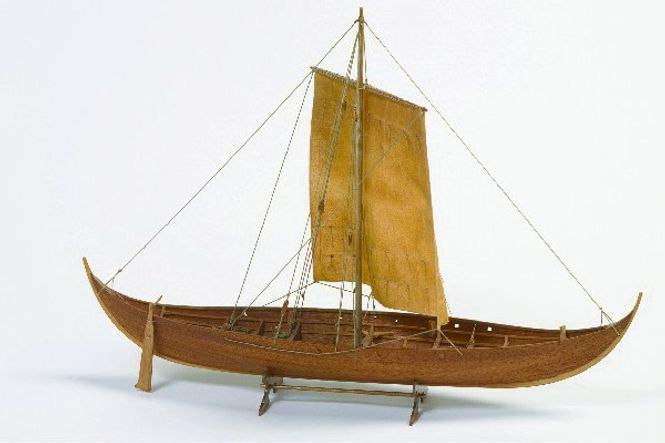
This Viking ship, dating from about 1000 A.D. was found in 1957 in the bay at Roskilde in Denmark. The wreck was salvaged in 1962, and after a thorough preservation it was possible to carry out a reconstruction of the vessel. Today the ship is on display at the Viking Ship Museum in Roskilde.
Building Instructions are in:
English, French, German, Danish, Dutch, Spanish, Italian and Portuguese
Three Mastet Topsail Schooner 'SIR WINSTON CHURCHILL' was built in 1965 at the Richard Dunston Ltd., Shipyard in Hessle, Yorkshire, GB, for the 'Sail Training Association' in Bosham. The constructors of this ship were Chamber & Nicholsen Ltd. The 'Sir Winston Churchill' is also equiped with a 240 HP help-engine and has a total sailarea of 817 sqm.
The tugboat HOGA was approved on 22th May 1941 by the American Navy and dubbed 'YT146HOGA', after which it was stationed at 14th the Pearl District district. After almost half a yearin service, HOGA was put on a bigger test than was ever thought of, the attack on Pearl Harboron December 7, 1941. HOGA fought for 48 hours to extinguish fires, bug bombed warships andsave sailors from the pressure loss. Today, HOGA is the only existing vessel after the Japanese attack.
A Classic American runabout from the mid-1920s. This type of boat was mainly used as racing boats, but in some cases also as tenders, for those who had a lager yacht. Racing boats from that time was build in beautiful classic materials such as teak and mahogany. If you had a 100-150 hp engine back then, you had one of the most powerful engines. The model is based on a fast 34 foot tender.
Building Instructions are in:
English, French, German, Danish, Dutch, Spanish, Italian and Portuguese
The Andrea Gail, an un-inspected commercial fishing vessel departed Gloucester Harbour, Massachusetts, September 20, 1991 with six crewmembers on board. The crew intended to make a fishing trip for swordfish in the area of the Grand Banks of Newfoundland, Canada. The vessel and six crewmembers remain missing and are presumed lost at sea in a major storm, referred to as the “Perfect Storm” by a meteorologist and made famous by Sebastian Junger’s book (the book was later turned into a Hollywood movie).
'NEW UPDATED VERSION WITH WOODEN HULL'
RS1 was built in 1893 for the “Norwegian Society for Shipwreck Salvage” at the Colin Archer shipyard in Rekkevig near Larvik, Norway. RS1 was later named “Colin Archer” after its designer and builder. The sharp-sterned design of the vessel has given it world-wide reknown. Roughly 30 boats of this type were built, most of them at the Colin Archer shipyard at Tollerodden in Larvik. RS1 Colin Archer has had an eventful past. After 40 years as a salvage vessel, the ship was sold in 1933 to private owners, who added a small auxiliary motor. It crossed the Atlantic in 1938, suffered severe storm damage in North Carolina in October 1954, and was found as a wreck on the Potomac River in 1960. After 23 years in the USA, the Colin Archer was returned to Norway in December of 1961 as deck cargo on the freighter “MS Tasco”. Then followed a series of owners - and both good and hard times. Finally, on 21 April 1972, the oldest salvage vessel in Norway was handed over to the Norwegian Maritime Museum in Oslo. In 1973, responsibility for the vessel was given to the Colin Archer Cutter Club, which has since completely restored the ship and sails it, in agreement with the Norwegian Maritime Museum, as a functioning reminder of the past. Today the Colin Archer is a welcome guest at vintage ship gatherings in Northern Europe.
Building Instructions are in:
English, French, German, Danish, Dutch, Spanish, Italian and Portuguese
The ship is the sixth to carry the name Esmeralda. The first was the frigate Esmeralda captured from the Spanish at Callao, Peru, by Admiral Lord Thomas Alexander Cochrane of the Chilean Navy, in a bold incursion on the night of 5 November 1820. The second was the corvette Esmeralda of the Chilean Navy which, set against superior forces, fought until sunk with colors flying on 21 May 1879 at the Battle of Iquique. These events mark important milestones for the Chilean Navy and the ship‘s name is said to evoke its values of courage and sacrifice. Construction began in Cádiz, Spain, in 1946. She was intended to become Spain‘s national training ship. During her construction in 1947 the yard in which she was being built suffered catastrophic explosions, which damaged the ship and placed the yard on the brink of bankruptcy. Work on the ship was temporarily halted. In 1950 Chile and Spain entered into negotiations in which Spain offered to repay debts incurred to Chile as a result of the Spanish Civil War in the form of manufactured products, including the not yet completed Esmeralda. Chile accepted the offer and the ship was formally transferred to the ownership of Chile in 1951. Work then continued on the ship. She was finally launched on 12 May 1953 before an audience of 5,000 people. She was christened by Mrs. Raquel Vicuña de Orrego using a bottle wrapped in the national colors of Spain and Chile. She was delivered as a four-masted topsail schooner to the Government of Chile on 15 June 1954, Captain Horacio Cornejo Tagle in command.